  |
 |
|
|
Tips and Techniques Care of Mokume-gane The metals used are chosen to have the greatest possible contrast in color. This contrast is enhanced by the patination or darkening of the copper or copper base alloys. For most people, the patination is self regenerating, but in some cases the patina will wear off, leaving bright copper. If repatination is desired, rub the item with a mixture of very mild ammonia and salt or with Baldwin's Patina, available from Reactive Metals Studio at 1-800-876-3434. Rio Pattern Develop Workshop (pdf)
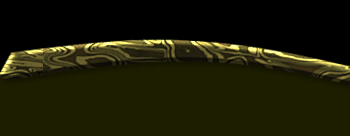
Technical Information for nickel silver/bronze mokume-gane (NS/Br)Shining Wave Metals, a commercial producer of mokume-gane since 1984, now offers a line of this material that specifically meets the needs of knifemakers. The Knifemaker's Line is composed of nickel-silver and a red bronze to meet the maker's need for a mokume with a combination of a bold pattern, high strength, good formability and good machinabilty. Note: Nickle Silver/ Bronze Mokume (NS/Br) contains the metal nickel, known to cause cancer in laboratory animals. Some indiviguals may experience allergic reactions in the form of rashes or other irritation. Avoid inhaling the dust while working the metal. A high degree of skin contact is not recommended. This product may not be used for jewelry in the European Economic Community (EEC). (Click a subject to expand text) ForgingThis mokume -gane will work similarly to nickel-silver. It may be cold forged, with a 30% reduction between annealing. This material may be hot forged, but doing so will void the warranty. Start hot forging at about 1400°, a medium red, and stop at a black heat. Be sure to avoid heat fatigue by working the metal sufficiently during each heat. MachiningThis material machines differently than leaded brass, the standard for copper base metals. Most bronzes are somewhat mushy and grabby on the tools, if difficulty is encountered machining Knifemaker's Mokume, try the following:
The first factor is the most important. In drilling heterogeneous materials it must be noted that breakage is a problem, this characteristic is used in safe construction. If the drills are sharp, (TiN coated drills work the best) with a high speed, light feed and good cutting fluid, this material will drill easily. A dull drill is indicated if high pressure is needed to make it cut. Sanding and polishingNS/Br may be machined, ground, sanded and polished similarly to nickel-silver or brass. Care should be taken in grinding and buffing not to smear the surface of the metal as this will show in the pattern. Lea compound may be used in place of sanding belts for finishing grinds. To bring to a high polish, sand to 600 grit and then buff with "White Diamond" buffing compound on a muslin wheel. Be sure to wear a dust mask during any sanding and polishing operations. Thermal operationsAnneal this metal at 1250ºF to 1350ºF (675ºC to 732ºC) and quench. Pickle to remove heat scale using a jewelers pickle or white vinegar. Avoid soaking the metal at the annealing temperature for more than 15 minutes. NS/Br may be both soft and hard soldered without difficulty using any method. Do not braze with rod that melts above 1,600ºF (870ºC). TIG welding is not recommended. Be sure to use adequate ventilation for all heating operations. EtchingNS/Br may be etched using several acids; however, a ferric chloride solution is recommended. If deep etching, clean all surfaces during the etch by brushing to remove residue. More dilute solutions give a cleaner etch, we recommend a dilution that looks like weak coffee. The nickel silver will etch high. Be careful not to over etch. Neutralize the etchant with a sodium bicarbonate solution after the desired depth is reached. Observe standard precautions for using acids. Post-etch surface treatmentTo enhance the pattern after etching, power brush with a very fine stainless brush and/or buff lightly with a soft wheel and a stainless buffing compound. Clean off residual compound with either acetone or a citrus cleaner. Large numbers of parts may be tumbled with a very fine plastic media or steel shot. Various patinas may be used to enhance the pattern. Be sure the surface is very clean before applying patina solutions. A patina that gives the same colors are extensive handling is Baldwin's Patina available from Reactive Metals Studio, 800-876-3434. Liver of sulfur or calcium polysulfide (available in garden supply stores) will darken the bronze. Commercial brass black or steel bluing solutions containing selenium will darken both the bronze and the nickel silver. Patina is worth experimenting with, try it!!
OverviewThe final finish on a mokume-gane work is what is going to make the piece pop. A fairly bland surface with little visible pattern is transformed to a strong visual element and shows the mokume off to its best advantage. There are a few general considerations. Somewhat matte surfaces show pattern (and form) better than highly polished ones. Patterned metals my have their surfaces enhanced by two main techniques, etching and patination. Etching selectively removes one metal by chemical action leaving the un-etched portion high and it gives the pattern a topography or literal texture. It will often make the surface of the deep etched component metal somewhat more matte creating a stronger visual contrast. Patina changes the color of the metal, usually by selective oxidation and can have the effect of preferential darkening one of the component metals thus increasing contrast. Copper and copper alloys, when combined with precious metals, give the strongest possible contrast because of the ability to both etch and patina the copper. Surface preparation for etchingPrecious metal/copper mokume may be finished using standard metal finishing techniques. It is best to avoid processes that can smear the surface such as heavy grinding or buffing, as this will muddy the pattern. Use processes that cut cleanly, if stock removal is required. Non-woven abrasives are excellent for this. The prep finish should be fine but not to a polish. 600 grit or 4-0 steel wool finishes are more than adequate. Hammered surfaces should be pre-finished to very clean before the final course of hammering and then pickled brushed. The surface should be degreased with soap and water, "Simple Green" or a citrus cleanser. "No-Name Patina Prep" from Reactive Metals Studio (RMS) is a dry powder that is used with water and a sponge and is excellent for both degreasing and giving the surface a light matte "tooth" that the etchant can easily work on.Areas not to be etched should be masked with fingernail polish, plastic tape or some other ground. All solder seams that are not made with gold solder should be masked. EtchingEtching may be done with 15-20% nitric acid solution, aqueous ammonia, vinegar, pickle or by reverse plating. "Multi-etch" is available from RMS and does not touch silver. In the etching of precious metal/copper mokume the copper or copper alloy will be preferentially etched leaving the silver or gold high. The apparent layer thickness of the copper will be reduced and if the work is over-etched the copper may disappear altogether. Special for gold, palladium and platinum alloys combined with sterling: Etch using a 25% to 35% nitric acid solution. Ferric chloride will etch silver but will leave it a very ugly grey that is difficult to remove. The use of aqua regia for etching is not recommended due to safety considerations. Be sure to follow proper safely procedures when working with any chemicals, especially corrosive types. Adequate ventilation is very necessary for nitric acid solutions, ammonia and Multi-Etch. Dispose of the spent chemicals responsibly, please. When etching be sure to have a neutralizing solution, usually baking soda in water, ready to stop the etch. Ideally there should be three containers, the etching solution, the neutralizing solution and a rinse solution of clean water. To etch, immerse the work in the etchant. Weak etchants such as vinegar and household ammonia may take as long as several days to reach the desired degree of etching depth while stronger etchants might take only a few minutes. It is not a good idea to leave items being etched unattended. It is important to periodically clean the surface of the object using a brush to remove oxide deposits. Some copper alloys, such as shibuichi will develop a depletion-plated skin during the etching process. When the desired depth of etch is reached, neutralize the acid and rinse. Post-etch finishingPost-etch finishing includes mild surface refinement often by lightly brushing with mild polishing compounds, a light buff to brighten the highlights or rubbing with abrasive powders to give a matt finish. Blasting with glass beads or fine abrasives will give a somewhat stronger matte surface. Plastic circular brushes with imbedded mild abrasives are very effective in refining etched surfaces. Do not to be too aggressive with the final finish, it can wipe the etch and the work will need to be re-finished. Special for gold, palladium and platinum alloys combined with sterling: karat golds combined with sterling silver often look washed out after etching. This is because some of the silver plates onto the gold during the etch. To remove the silver layer brush the items with a brush loaded with tripoli followed by a light buff using hard felt and white rouge. Very light hand sanding with a fine paper can also remove the silver plating layer. After the silver layer is removed, proceed to creating the final surface finish. karat golds combined with sterling silver often look washed out after etching. This is because some of the silver plates onto the gold during the etch. To remove the silver layer brush the items with a brush loaded with tripoli followed by a light buff using hard felt and white rouge. Very light hand sanding with a fine paper can also remove the silver plating layer. After the silver layer is removed, proceed to creating the final surface finish. PatinaPatina is the final step. Most copper alloys will color by handling but if a faster or more specific color is desired, two patina solutions work well. "Baldwin's Patina" will color most copper alloys (except brass and nickel silver) and will not color silver or gold. Rokusho, a traditional Japanese simmering patina gives different colors including a striking brick red/orange on copper. It is available from RMS. Heat colors on copper, produced by oven baking from 300 F to 550 F. can be striking, Special for gold, palladium and platinum alloys combined with sterling: few patinas look good on silver when in combination with gold, palladium or platinum. A light fuming with liver of sulfur can produce interesting results as can gentle heat, which can color red and yellow gold as well. Most precious metal/silver mokume is finished without patina. The application of all patinas require very clean surfaces, similar to etching. Apply the patinas as directed or experiment. Post patina treatment should be very mild, rub with a soft cloth or seal with wax. It much be noted that all patinas will wear, especially in items such as rings and bracelets, and will change over time and with handling. Final surface treatments for silver/copper and gold/copper mokume can be quite complex and changed by many factors and therefore tend to be highly individual. Experimentation is rewarding, if somewhat expensive. Enjoy the search! For technical support call or FAX Shining Wave Metals at 425-334-5569. |
|
||||||
|
||||||||||
|
||||||||||
© P. Baldwin 2009 |
||||||||||
|
||||||||||